“My fifteen-year-old daughter just wrote a research paper on this topic, and she was so moved by the precious children, that she asked to donate her own money to this cause. It's great that you have things on the web that can give these children exposure and a voice to those of us who may never personally meet one!” Lisa Hagen
Do you have questions you need answered for a school report? Do you want to learn more about the children? Are you interested in knowing more about Progeria and the work PRF does? We've got the answers for you right here!
1. I'm doing a school report on Progeria, can you help me get more information on this subject?
2. I heard that the Progeria gene had been discovered, where can I find out more about this?
3. Is Progeria a dominant or recessive disease?
4. I need to interview a researcher or other expert in the field of Progeria.
5. How many children in the world are diagnosed with Progeria?
6. Where do the children live?
7. Do the children participate in school activities, or are they limited because they have Progeria?
8. What is it like for a child to live with Progeria?
9. Does the disease affect their mental abilities?
10. Why do children with Progeria age in body so rapidly and not in mind?
11. What issues do you think are most important in the care of a patient with Progeria?
12. Are there any treatments available?
13. Are any scientists close to finding a cure?
14. What research are you currently doing on the disease?
16. I saw a program on TV and would like a copy of the tape.
17. What would you like people to know about Progeria now?
18. I would like to study Progeria for a career, what courses of study do you suggest I take?
19. I'd like to be a pen pal to a child with Progeria or send them a present.
20. I would like to talk to someone by phone or in person about living with Progeria.
22. What can people do to help? Where do you get most of your funding?
23. Is there a chapter near where I live that I can contact?
We love the fact that awareness about Progeria is spreading throughout the world and that you want to learn more, thank you! But we are so very busy at the office doing all the things that are needed to advance our mission of finding treatments and a cure that we can no longer individually answer the many requests we receive from around the world. Instead, we have prepared this Question and Answer sheet to help provide you with the information you're looking for, taking the most common questions we are asked and answering them below. We hope this helps you get top grades on your school report, or just helps you understand more about Progeria and The Progeria Research Foundation so that you can help spread the word about the wonderful work we are doing for these special children.
1. I'm doing a school report on Progeria, can you help me get more information on this subject?
In addition to finding the cure and effective treatments for Hutchinson-Gilford Progeria Syndrome, part of our mission is to promote public awareness of this disease. By doing a report on Progeria, you are helping us accomplish that part of our mission. Thanks so much, we're glad to help you!
Before you read any further, please visit our Frequently Asked Questions section to learn more about Progeria. Other sections you may find helpful are The Connection to Other Diseases , and The Science Behind Progeria. The information on those pages is not repeated here.
If you are looking for more advanced, scientific information, please visit http://www.pubmed.gov/ which provides abstracts for many scientific publications on Progeria.
For key scientific publications that have helped advance Progeria research since the 2003 Progeria gene discovery, visit our What’s News in Progeria Research section.
Also, you can access information on the NORD (National Organization of Rare Diseases) web site. Go to http://www.rarediseases.org/, and click on their Rare Diseases Database, then type “Hutchinson Gilford Progeria” in the search box, and a page on Progeria will appear. If you want a more detailed report, I believe it costs $7.50.
For books on Progeria, here are a few publications that you may find useful:
Keith Moore, father of a child who died of Progeria, wrote Old at Age 3, the story of Zachary Moore, to share the story of his son’s extraordinary life.
Dr. Leslie Gordon, PRF’s Medical Director, wrote a chapter on Progeria for the World Book Online Reference Center www.worldbookonline.com/wb/Article?id=ar447180 and the print edition of the 2008 World Book Encyclopedia
Dr. Gordon, W. Ted Brown and Frank Rothman wrote a chapter entitled LMNA and the Hutchinson-Gilford Progeria Syndrome and Associated Laminopathies for the book Inborn Errors of Development: The molecular basis of clinical disorders of morphogenesis (2007, 2nd ed.) 139: 1219-1229.
If you give us your address, we can send you a brochure and our latest newsletter to include with your report.
2. I heard that the Progeria gene had been discovered, where can I find out more about this?
On April 16, 2003, it was announced that the gene for Progeria had been discovered, and PRF played a major role in that discovery! Go to Progeria Gene Discovered for more information. Also, here are some cites to scientific articles on the gene mutation:
"Recurrent de novo point mutations in lamin A cause Hutchinson-Gilford Progeria Syndrome", Vol. 423, May 15, 2003, Nature.
"Mutation causes early-aging syndrome", Vol. 163, p.260, April 26, 2003, Science News.
"Cause of Progeria's Premature Aging Found; expected to Provide Insight into Normal Aging Process", Vol. 289, no. 19, pp. 2481-2482, May 21, 2003, JAMA.
3. Is Progeria a dominant or recessive disease?
It is Dominant.
4. I need to interview a researcher or other expert in the field of Progeria.
Unfortunately, we cannot provide interviews and we do not provide the contact information of others. However, our Medical Director has helped create this Q and A and all other information on Progeria that appears on this site, so perhaps that is sufficient to satisfy the interview requirement for your report.
In addition, click here to view a 1-hour presentation by PRF co-founders Dr. Leslie Gordon (PRF’s Medical Director) and Dr. Scott Berns (PRF’s Chairman of the Board)
5. How many children in the world are diagnosed with Progeria?
As of December 2010, there are 78 children living in 30 different countries who have been diagnosed with Progeria; however we believe that there are more children who have this condition, but have not yet been diagnosed. Visit http://www.findtheother150.org for ways you can help, and hear from parents and experts through podcasts.
6. Where do the children live?
Our information about children with Progeria is confidential, including details about where they live. However, Click here to view a map to see the approximate locations they reside in.
7. Do the children participate in school activities, or are they limited because they have Progeria?
Children with Progeria are able to participate in all the same educational programs and sports activities as other children. With the exception of having Progeria, these children are just like their peers - Most have no special capacities or limitations other than those that their shorter stature and perhaps stiff joints cause for some activities. More details on school and general aspects of living with Progeria can be found in chapters 16 and 17 of The Progeria Handbook.
8. What is it like for a child to live with Progeria?
John Tackett, our first youth Ambassador, was interviewed about what it's like to live with Progeria and other questions. You can find this information on our web site for PRF Spokespeople and at John Tacket Interview.
9. Does the disease affect their mental abilities?
Not at all. Children with Progeria are intelligent and full of energy just like other kids their age.
10. Why do children with Progeria age in body so rapidly and not in mind?
LMNA is not expressed by the brain cells, so the gene mutation does not affect the brain.
11. What issues do you think are most important in the care of a patient with Progeria?
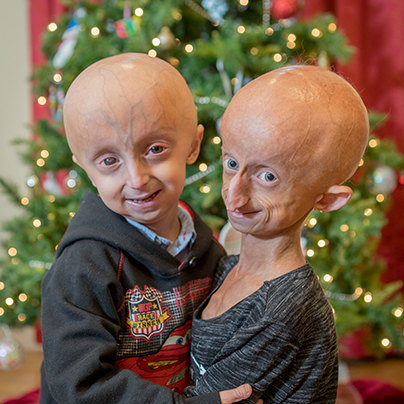
Most of all, it is important to remember that all children with Progeria have age appropriate intellect and personality. An eight-year-old with Progeria will think and act just like every other eight-year-old. Children with Progeria are smart and funny and full of life. It's the bodies of these children that are laden with the genetic predisposition toward conditions of aging and heart disease, not their minds. So they need their schools and communities and their friends to treat them just like any other child (with a few minor adjustments for size). After all, Progeria is just a small part of who they are!
12. Are there any treatments available?
Yes. In April 2010, The Progeria Research Foundation published The Progeria Handbook, for families and doctors. From basic health facts to daily care recommendations to extensive treatment guidelines, this 100-page handbook helps answer many questions for children with Progeria throughout the world. We don't have a cure yet, but we do know that daily care makes a huge difference in their quality of life. Proper nutritional, physical, and occupational therapies, along with preventative cardiac and other care are essential.
13. Are any scientists close to finding a cure?
The Progeria Research Foundation helped in the discovery of the gene that causes Progeria, and is now involved in clinical drug trials, testing drugs that show great promise to effectively treat children with Progeria. We have made tremendous progress, but no one can predict how long that will take.
14. What research are you currently doing on the disease?
See our Grants we have Funded section for project descriptions, our Clinical Trials updates and PRF In The News for the latest research findings.
15. I would like permission to use some of the photos and information from your website for my project.
It is fine to use any text information gathered from our website for your project. However, we would prefer that you not use photos of the children from our web site. We suggest you use our
brochure and newsletter, which have lots of photos of children with Progeria, as visuals. If you give us your address, we can send you one.
16. I saw a program on TV and would like a copy of the tape.
The Progeria Research Foundation does not sell videotapes about Progeria. These documentaries are privately produced and due to copyright restrictions, can't be sold by private organizations or individuals. You may want to contact the network on which you saw the documentary; they might provide you with one for a fee.
17. What would you like people to know about Progeria now?
While Progeria is an extremely rare disease - known to currently affect only 78 children worldwide (as of December 2010)- all
children with Progeria die of severe premature atherosclerosis (heart disease). When you help children with Progeria, you are helping to save the lives of children with a 100% fatal disease. At the same time, you are helping us all, because research in this field will not only help The Progeria Research Foundation toward our goal of finding a treatment and a cure, but may provide answers to the mysteries of the natural aging process, heart disease and stroke (one of the leading killers in the world).
18. I would like to study Progeria for a career, what courses of study do you suggest I take?
Wow - that's terrific! Depending on where you are in your education, this answer varies. We suggest that you consult with your guidance or career counselor at school for the best course of action.
19. I'd like to be a pen pal to a child with Progeria or send them a present.
Your idea of wanting to become pen-pals is really great, but all contact information for the families and the children is confidential, so we wouldn't be able to give you their names and email addresses. However, the links section lists some web sites for families with children that have Progeria. You can contact them through their web sites and ask if they'd like to have a pen-pal or a gift.
20. I would like to talk to someone by phone or in person about living with Progeria.
For the same confidentiality reasons as described in the answer above, we cannot put you in touch with someone to talk about living with Progeria. Please refer to #8 above to get information on this subject.
21. I'd like to volunteer to work with the children. Do you have a camp that you run, or is there a hospital that I can contact regarding working with children with Progeria?
We do not have programs where we have direct contact with the children in the way that you are thinking of. The children are located all over the world, and so our contact with the families is almost exclusively through email, phone and postal mail. There is no "camp" or other social meeting we are involved in that brings them together where you might have an opportunity to work with the children. But we can always use another volunteer on our team! Go to the Other Ways to Help section for more information.
22. What can people do to help? Where do you get most of your funding?
The Progeria Research Foundation has been able to do a tremendous amount with a small amount of money. We don't have an endowment fund, and rely on the continued support of others who support our mission. Every little bit helps - those ten and twenty dollar donations really add up! Please check out our Miracle Makers for just some of the great ways people have become involved, like a group of high school students who produced a performance, a French policeman who organized a flea market and a local bank that held a casual day - all to raise funds for PRF.
Every donation counts, and will allow us to work faster towards a cure, to win this race against time for all children with Progeria throughout the world. The best ways people can help is by making a donation, organizing a fundraiser and getting others to donate.
23. Is there a chapter near where I live that I can contact?
PRF now has several chapters in the United States! Visit our Chapters section to support a chapter in your area, and read all about the wonderful work these groups are doing to help in our quest for a cure. We'd love for you to join our chapters in any way you can - Together, we WILL find the cure!